We have paid a partner to run the ERP project. Why are we still the ones who have to decide things?
Because a partner can configure software, migrate data and write code, and cannot decide how your company wants to operate. Effective ERP implementation is mostly a matter of the buyer making a short list of decisions on time and then refusing to reopen them. The questions below are the ones a buyer with a chosen vendor and an approved budget tends to ask, answered one at a time.
Who has to be named before the partner starts?
Three roles, and all three live inside your company.
A sponsor with budget authority attends the steering meetings, reads the status report and says yes or no to a change. When the sponsor delegates the role downward, decisions slow to the speed of the person who delegated.
A process owner for every area in scope. Someone in finance, someone in the warehouse, someone in sales must be able to say "this is how we will do it from now on" and have the team follow. Without that person the partner asks five people the same question, gets five answers, and builds all five.
A data owner rules on which customer record is correct, which price list is current and what the opening stock is. A consultant cannot make those calls, because the consultant is not accountable when they are wrong.
Write each name into the project charter, then write the hours. A process owner who is assigned to the project and also keeps a full operational job is not assigned, and the project shows it within weeks.
How do we keep scope from growing?
Treat scope as subtraction. Every project starts with a list of what the system will do. The ones that work spend equal energy on what it will not do in the first release.
Write a change rule before the first request arrives: any addition must name what leaves or what date moves, and the sponsor signs. It sounds bureaucratic until the first request comes from someone senior. Then the rule turns an argument about people into a question about trade-offs, and it can only do that if it existed beforehand.
Customization is the usual vehicle for growth, and its cost outlasts the project, since custom code must be tested and maintained through every upgrade. Ask the partner for a customization register: each item, its business reason, and the estimated annual cost of keeping it. An item nobody can justify goes back to the standard workflow.
How do we get people to use it?
Switch off the alternative. People use whichever system the work cannot proceed without, so on go-live day make the old system read-only, remove edit rights from the shared spreadsheets, and stop accepting orders by email unless someone enters them. It feels harsh. It is kinder than running two systems for a year, which is where a project ends up when the old way stays open.
Training follows that rule and does not replace it. Train by role, on your own data, and give each department a champion who learned early and answers questions in the first month. A generic all-hands session teaches nobody anything specific.
What do we measure?
Two things, and publish both. Dashboards multiply in the first month; resist.
The first is time to close the month, against the old process. The second is the number of transactions handled outside the system, such as invoices written in a spreadsheet or stock moved without a record. One tells you the numbers can be trusted, the other tells you whether people are using the thing at all. Neither needs an outside benchmark. Your own baseline from before go-live is the comparison that counts.
What changes now that AI is arriving?
We think implementation quality is the AI strategy. Assistants and agents depend on records that are consistent, complete and in one place. An ERP delivers that only if the data was cleaned before migration, the processes were standardized and not simply copied, and people actually record transactions in the system. A project that cuts those corners produces a database AI cannot use well, however good the model. For where AI genuinely helps once the foundation exists, read how AI improves decisions in Odoo.
Where do we go next?
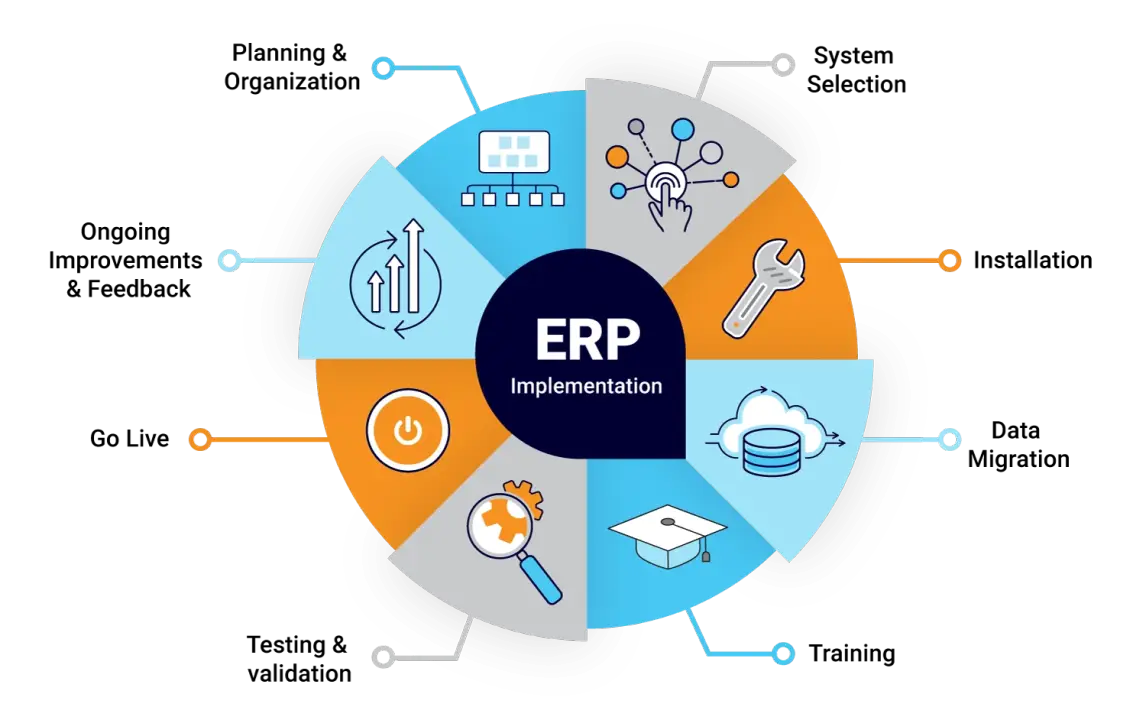
For the phases of an Odoo project, with fit-gap, migration and cutover covered step by step, see the Odoo implementation guide. If you already hold a proposal, the proposal checklist shows what to demand before you sign. For a second opinion on how your project is governed, see our ERP services or get in touch.