Every AI agent your team ships eventually needs to talk to something else: a CRM, a database, a second agent built by a different vendor on a different framework. Until recently, every one of those connections was custom code. That changed fast. By March 2026, the Model Context Protocol (MCP) had reached 97 million monthly SDK downloads, and Google's Agent2Agent protocol (A2A) had crossed 150 supporting organizations in production, according to the Linux Foundation and Atlan's 2026 research on agent interoperability.
The reason this matters is not the download count. It is what happens without a shared standard: multi-agent systems built on bespoke integrations show failure rates between 41% and 86.7% in production, and roughly 79% of those failures trace back to coordination and specification problems, not to the underlying models being wrong. If you are building AI agents that touch real business systems, the protocol layer under them is no longer a technical footnote. It decides whether the system holds together.
Two different problems, two different protocols
MCP and A2A get treated as competitors because their names keep showing up in the same sentence. They are not. They solve different layers of the same stack.
MCP (Model Context Protocol), released by Anthropic in late 2024, standardizes how a single agent connects to tools, APIs, and data sources. Before MCP, an agent that needed to read a database, call a REST API, and pull a document needed three separate, hand-built connectors, each breaking independently whenever the tool on the other end changed. MCP replaces that with one interface: any tool that publishes an MCP server can be reached by any MCP-compatible agent, no custom glue code required.
A2A (Agent2Agent), released by Google in April 2025 and now under the Linux Foundation, standardizes how separate agents, built by different teams on different frameworks, discover each other and hand off work. An agent advertises what it can do through a machine-readable "Agent Card." A second agent reads that card, sends it a task, and tracks its status through a standard lifecycle. That is what lets a support agent delegate a refund to a billing agent it has never talked to before, without anyone writing point-to-point integration code.
Put simply: MCP is how one agent reaches your systems. A2A is how many agents work as a team. Production deployments increasingly need both.
What the standard actually saves
The clearest number here is not adoption. It is the time cost of the old way of doing things. Per Digital Applied's 2026 MCP adoption data, cited by Atlan, the average time to wire a new SaaS tool into an AI agent dropped from about 18 hours of custom function-calling code to roughly 4.2 hours with MCP in place.
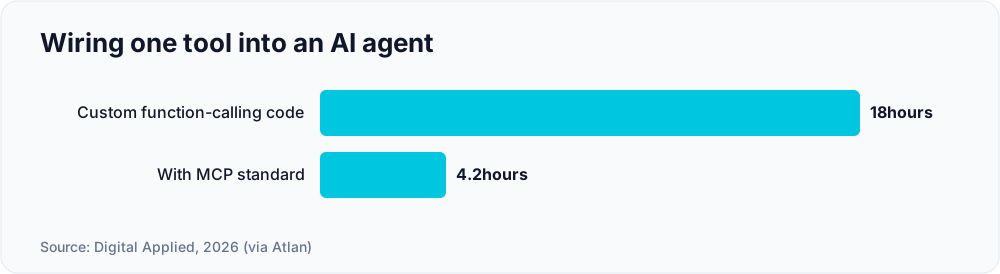
| Integration approach | Time to wire in one tool |
|---|---|
| Custom function-calling code | 18 hours |
| With MCP standard | 4.2 hours |
That gap compounds. Gartner projects that 40% of enterprise applications will feature task-specific AI agents by 2026, up from under 5% in 2025, according to the same Atlan research. Every one of those agents needs tool access, and most need to coordinate with at least one other agent. Hand-coding that integration surface at 18 hours per connection does not scale past a handful of agents. A shared protocol is what makes the difference between a pilot and a production estate.
Why this is a governance question, not just an engineering one
Standardizing how agents connect does not remove the need to govern what they are allowed to do once connected. An MCP server that exposes a database read tool is only as safe as the permissions behind it. An A2A Agent Card that advertises "can issue refunds" needs the same authentication and audit trail you would put behind any human process with that authority.
We have written before about what happens when that governance step gets skipped: the gap between running agents and actually watching what they do, and the specific risk prompt injection poses once an agent holds real credentials. Interoperability protocols do not fix either problem on their own. They make the underlying architecture consistent enough that governance, logging, and access control can be applied once, at the protocol layer, instead of once per bespoke integration.
What this means for a mid-market rollout
Most teams outside the hyperscalers are not building a swarm of a dozen coordinating agents this year. They are usually trying to get two or three working reliably: a support agent, an operations agent, maybe a reporting agent pulling from the ERP. Even at that scale, the protocol choice matters:
- Pick MCP-compatible tools where you can. If your ERP, CRM, or internal API already exposes an MCP server, or a vendor roadmap promises one, that is real integration time saved later, not a checkbox.
- Do not build custom agent-to-agent handoffs you will have to maintain. If two agents from different vendors need to hand off work, look at whether an A2A-compatible pattern already exists before writing bespoke glue code that only your team understands.
- Treat the protocol as a place to enforce governance, not skip it. Standardized connections make it easier to log, permission, and audit agent actions consistently. Use that, do not assume it happens automatically.
This is the same lesson we keep coming back to in agentic AI rollouts that go wrong: the model is rarely the reason a deployment fails. The wiring around it is. Interoperability protocols are the industry finally standardizing that wiring instead of every team reinventing it.
If you are scoping an agent rollout and want a second opinion on where MCP or A2A fits your stack, before you write another custom connector, our AI services and IT support teams can walk through the architecture with you. You can also see how this fits into a broader digital transformation approach or get in touch directly.