Most companies did not fail at agentic AI because the model was weak. They failed because they built one broad agent to do everything, and a broad agent that touches everything ends up accountable for nothing. The organizations actually running agents in production this year did the opposite: they built narrow, task-specific agents that own one job end to end, and left the general-purpose assistant for drafting emails.
The gap between intent and production is real, and it is not closing on its own
Ninety-three percent of IT leaders say they plan to introduce autonomous agents within two years, according to the MuleSoft/Deloitte Digital Connectivity Benchmark, cited in Axis Intelligence's 2026 research. McKinsey's November 2025 State of AI survey found that 62% of organizations are experimenting with agents, but only 23% have scaled one into production in even a single business function, and fewer than 10% have scaled agents across multiple functions. Axis Intelligence calls the 70-point spread between those two numbers the AI Agents Deployment Gap Index, and it is the most useful number in the whole debate: it says the bottleneck is not model capability, it is scope.
Gartner's read points the same direction. The firm forecasts that 40% of enterprise applications will embed task-specific AI agents by the end of 2026, up from under 5% in 2025. That is not "AI agents" as a category growing eight-fold. It is task-specific agents specifically growing eight-fold, while general-purpose agents remain stuck in pilot. And governance has not kept pace with either: Deloitte's 2026 State of AI in the Enterprise found only 21% of organizations have a mature governance model for the agents they already run, which is its own reason to keep an agent's blast radius small.
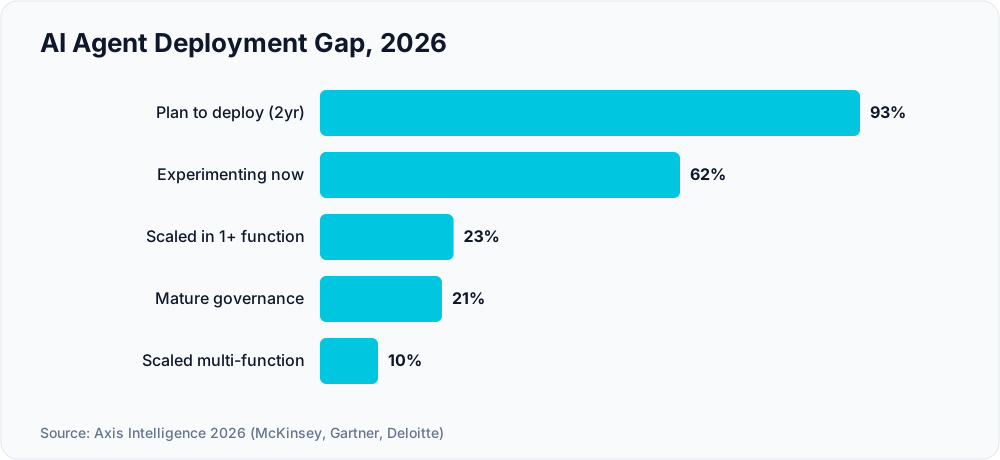
| Stage | Share of organizations |
|---|---|
| Plan to deploy agents within 2 years | 93% |
| Currently experimenting with agents | 62% |
| Scaled an agent in at least 1 function | 23% |
| Have mature governance for agents | 21% |
| Scaled agents across multiple functions | Under 10% |
Source: Axis Intelligence, AI Agents Statistics 2026, compiling McKinsey State of AI (Nov 2025), Gartner (Aug 2025), and Deloitte State of AI in the Enterprise (2026).
Why a general-purpose agent stalls and a vertical one does not
A general-purpose agent has to be told, in the prompt, what "correct" looks like for every task it might touch: how your business approves a discount, what counts as a duplicate vendor, when a refund needs a second signature. That knowledge lives in your ERP workflows, your approval chains, and your data, not in the model. Every time the agent meets a case the prompt did not anticipate, someone has to step in, and that is the production-stalling pattern the deployment gap actually measures.
A vertical agent, scoped to one job, only needs to encode one set of rules, against one set of systems, with one clear owner who can say whether an action was right. That is a smaller integration problem, a smaller governance problem, and a smaller blast radius if it fails, which is also why it is easier to give the 21% of organizations with mature governance something they can actually certify.
Three things a vertical agent needs that a chatbot demo skips
A defined boundary of authority. The agent should be able to state, in plain terms, which actions it can take on its own and which it must escalate. If that boundary cannot be written down in a sentence, the agent's scope is still too broad.
A system of record it reads and writes correctly. A vertical agent is only as reliable as the ERP, CRM, or ticketing system underneath it. An agent that reasons well but writes bad data into your accounting system has made the problem worse, not smaller.
An owner who can audit its decisions after the fact. Someone in the business, not just in IT, needs to be able to look at what the agent did last week and confirm it was correct. Without that owner, the 40%-plus project cancellation rate Gartner forecasts through 2027 becomes a self-fulfilling outcome.
What this means for an SME choosing where to start
Do not start with "an AI agent for customer service" or "an AI agent for finance." Start with one recurring task inside customer service or finance that already has a clear rule and a clear owner: matching purchase orders to invoices, triaging support tickets by category, flagging vendor records that look duplicated. Ship the narrow version, measure what it gets right and wrong for a real quarter, then widen its authority once the audit trail earns that trust. That sequencing is also how you avoid rebuilding the same agent twice, a mistake we cover in more detail in why agentic AI implementations fail.
This is the same principle behind ThinqHub's AI services: an agent is only as good as the operational groundwork under it, so we scope one workflow at a time inside your existing ERP and IT operations before any automation goes live, following the approach we apply to every engagement. The businesses closing the deployment gap are not the ones with the most capable model. They are the ones that picked one job, gave the agent a clear owner, and proved it before asking for the next one. If you are weighing where to start that first vertical agent, talk to us about the workflow it should own.