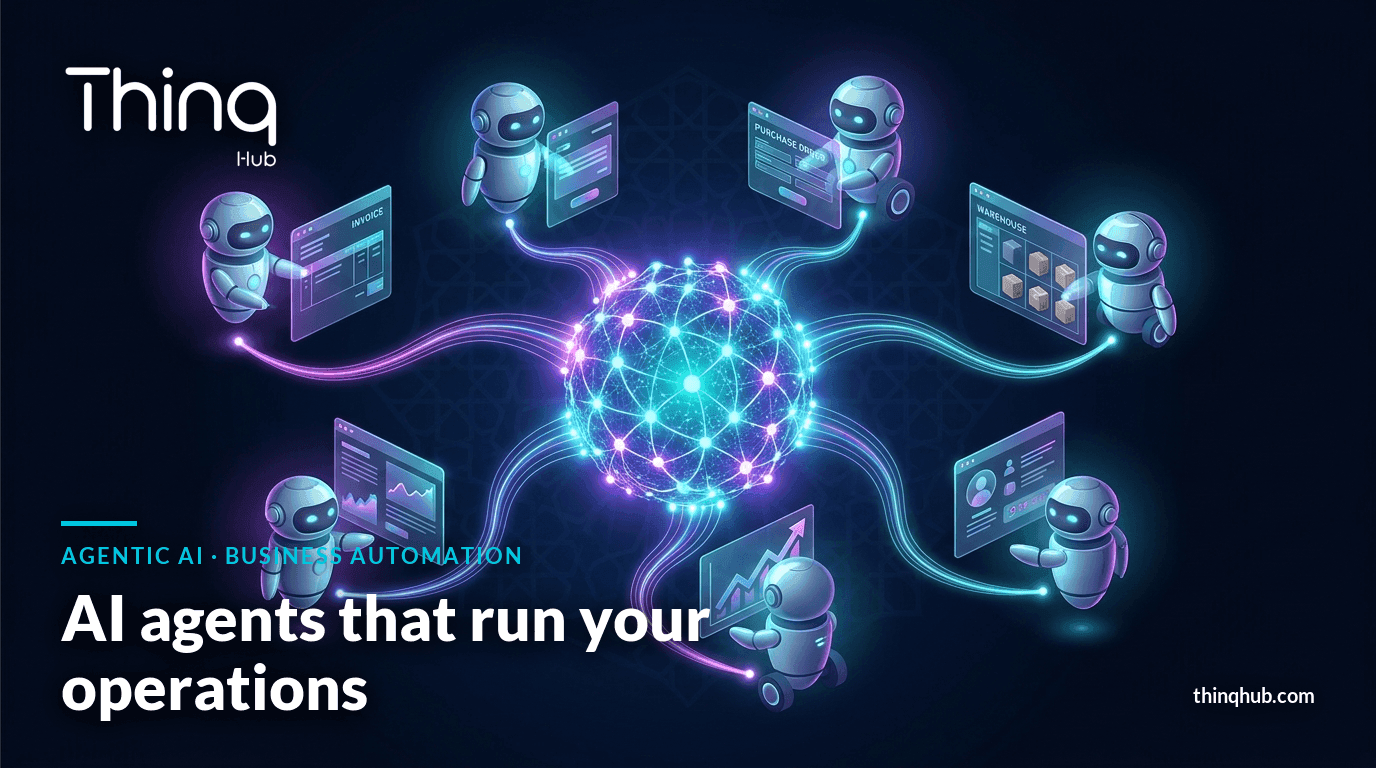
"Agentic" is being asked to carry three meanings at once, and the people selling it benefit from the confusion.
Meaning one: a chatbot that can call a tool. It answers a question, then looks up an order. Meaning two: a fixed workflow with a language model in one step, such as reading an email and filling a form. Meaning three: software that chooses its own next step toward a goal, and carries it out. MIT Sloan defines agentic AI in this third sense, as "autonomous software systems that perceive, reason, and act in digital environments to achieve goals on behalf of human principals." Most of what is sold under the word is the first or the second, priced as the third.
That matters for agentic AI business automation because the three carry different risks. The first can only be wrong in words. The second is wrong in a way you can predict, since someone wrote the branches. Only the third is wrong in ways nobody listed beforehand. A script that sends a reminder to every customer with an overdue invoice fails predictably. An agent that reads the customer's history, decides this one should wait a week and drafts a softer message has judgment, and judgment comes with an error rate. If you are told you are buying the third and cannot see what it checks its decisions against, you are probably buying the second.
The common advice is to pick an agent platform and then connect it to your systems. We think that order is backwards.
Start where mistakes can be seen, undone and attributed. For a business that runs an ERP, that place is the ERP. ThinqHub implements Odoo and ERPNext, and we think agents should be built against them, not beside them. That is a position, so here is the reasoning.
Inside the system of record, for four reasons
You can wire an agent to your business from the outside, with credentials and calls, or build it as a participant in the system, acting as a user with a role. We prefer the second.
Permissions already exist. An ERP knows who may approve a purchase over a threshold and who may see payroll. Odoo and ERPNext both ship role-based permissions, with record-level restrictions available. An agent acting as a user with a narrow role inherits those limits. An agent behind a shared service account usually ends up with broader access than any employee, because that is the easy way to make the integration work.
The audit trail is already there. Odoo records changes to tracked fields in a record's chatter, and ERPNext can track changes per document type. When an agent changes a due date or reroutes an order, the change appears where finance already looks, with a timestamp and an actor. An agent keeping its own log in its own tool gives you a second place to look and a reconciliation problem.
There is one version of the facts. An agent working from an export, a vector index of last week's data or a spreadsheet acts on a picture of the business that is already stale.
Undo is possible. If an agent mislabels two hundred sales orders, the fix should be a filter and a bulk edit in the system your team knows, not forensics across three tools.
The cost is real. It is slower to start than pasting an API key into an agent builder, and it forces a decision about what role the agent holds, a conversation some businesses would rather skip. That conversation is the point. If you cannot say what an agent may do in one sentence, it is not ready to do it.
Which workflows, sorted by the cost of a mistake
Lists of use cases are sorted by how impressive they sound. Sort by what a mistake costs instead.
| Workflow | First version (reads and proposes) | Second version (writes) | What a mistake costs |
|---|---|---|---|
| Lead qualification and routing | Checks duplicates, scores fit against rules your sales lead wrote down, suggests an owner | Assigns the owner and logs it | A lead sits with the wrong person for a few hours |
| Inventory reconciliation | Compares counts, shipments and sales orders overnight and lists discrepancies | Posts adjustments. We would not allow this one. | A quiet rewrite of inventory value |
| Accounts receivable follow-up | Drafts a reminder in Arabic or English from the payment history | Sends it | Goodwill with a customer who paid yesterday or is mid-dispute |
| Procurement approvals | Validates, routes and reminds against budget rules | Approves spend. Keep it a human click until a low-value category has run in shadow mode. | Money leaving the account |
Read the table from the top and you have the order of attack. Lead routing is the safest place to learn how an agent behaves. Inventory deserves a hard line: letting an agent post stock adjustments turns a reporting tool into something that rewrites your books, and read access plus a proposed fix, approved by a person, captures most of the benefit. Receivables is where errors become visible outside the company, so start with the agent drafting and a person sending, and move to autonomous sending only for accounts where a wrong message is cheap. In each row the sensible first version reads and proposes, and teams that jump to the second are the ones who later explain to finance why a spreadsheet and a chatbot disagree.
What your ERP has to look like first
An agent is the fastest data audit you will ever commission, because it reads every record and acts on all of them. With two customer records for one company, a reminder agent chases both, and one may be for an invoice already settled under the other. If product codes were never standardized, the reconciliation agent reports that half your stock does not match.
Two things need to be true first. The rules must be written down: what value needs a second approver, which customers get a phone call and not an email, what stock level triggers a reorder and who decided it. If those answers live in one person's head the agent guesses or stalls, and writing them down takes a day and helps the human process whether or not an agent ever arrives. And the master data must be trustworthy enough to act on. It does not need to be perfect. Resolve the duplicates in customers and suppliers and make identifiers consistent for whatever the agent touches. Clean the slice it will use, not the whole database.
Businesses in Egypt and Saudi Arabia carry an extra consideration: invoices flow to a tax authority, the ETA in Egypt and ZATCA in Saudi Arabia, so anything an agent does near invoicing sits in a regulated flow. That argues for keeping agents on the reading and drafting side of anything that touches an issued tax document, and keeping submission, cancellation and credit notes behind the ERP's approval controls and a named person's sign-off.
Pick the top row. Run the agent for a few weeks in shadow mode, where it proposes and a person does the work as before, then compare. The disagreements are your test suite, and they teach you more about your rules than any vendor demo. Then let it act on the cheap cases, keep a person on the expensive ones, and measure one number: the time a person spends on that workflow, before and after.
We build this way through our AI services, and the groundwork of clean records and documented rules is the same work as any end-to-end ERP project. If you want to know which of your workflows is ready, talk to us. For the failure patterns that sink agent projects before this point, read why agentic AI implementations get canceled.
Build around your operations, then put the agent where your operations already keep their records.
Source for the definition: MIT Sloan, Agentic AI Explained.