A year ago, whether a business should let an AI agent write production code was still a debate. It is not anymore. As of May-July 2026, 90% of professional developers use an AI coding agent at work at least weekly, and 68% use one daily, according to the JetBrains Developer Ecosystem Survey 2026, a study of more than 15,000 developers worldwide. The question has shifted from "should we" to "why is our agent still stuck in a pilot."
That second question matters more for most businesses than the first. Coding agents are now a mainstream part of how software gets built, but the gap between a business trying one and a business running one in production is wide, and it is where most of this year's AI budget is either paying off or quietly disappearing.
The tool landscape moved fast, and it is still moving
Eighteen months ago, GitHub Copilot was the default answer to "which AI coding tool." That is no longer true. Per the JetBrains survey, Claude Code grew from 18% adoption in January 2026 to 39% by mid-year, more than double GitHub Copilot's 21% (down from 29% a year earlier). Cursor sits at 12%, OpenAI's Codex jumped roughly fivefold to 16% in the same window, and open-source entrant OpenCode reached 7% adoption with almost no marketing budget behind it.
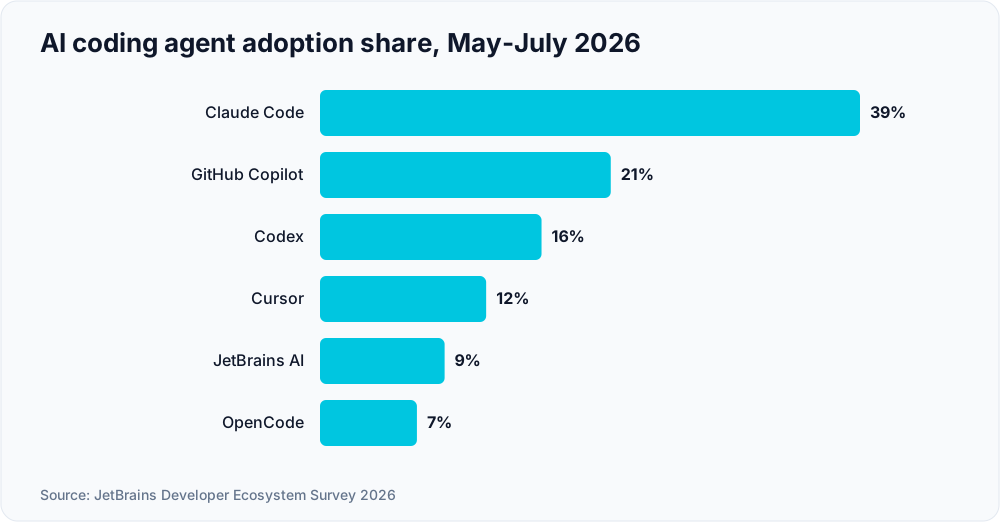
| Tool | Adoption share |
|---|---|
| Claude Code | 39% |
| GitHub Copilot | 21% |
| Cursor | 12% |
| Codex | 16% |
| OpenCode | 7% |
| JetBrains AI | 9% |
Source: JetBrains Developer Ecosystem Survey 2026.
The practical lesson for a business is not "pick the tool with the biggest share." It is that the tool landscape churns in months, not years. Any implementation plan that locks a team into one vendor's agent as a permanent decision is already out of date the day it ships. A better approach treats the agent as a replaceable layer behind a stable delivery process, which is the same principle behind avoiding a single-ERP-vendor lock-in for the rest of the stack.
The productivity numbers hold up, with a catch
The gains are real where they have been measured under controlled conditions. Developers using AI coding tools report completing tasks 55-56% faster with higher completion rates, and daily users merge substantially more pull requests than light users, per data compiled in Digital Applied's 2026 AI coding adoption review, which aggregates the Stack Overflow, JetBrains, and DORA survey results.
The catch is trust. Only 29% of developers trust AI-generated code to be accurate, down from 40% two years earlier, and AI-coauthored pull requests carry more reported issues than human-only ones, according to the same review. Speed went up. Confidence in the output did not follow it. That combination is exactly why an agent that writes code fast still needs the same review discipline, testing, and staging environment a human contributor would go through, not less of it. We wrote about the specific failure modes this produces in production in why agent observability is still a gap most teams have not closed.
The real bottleneck: production, not adoption
At the enterprise level, the more telling number is not how many developers touch an agent, it is how many organizations trust one enough to run it unattended. Gartner found that 80% of enterprise applications shipped or updated in the first quarter of 2026 embed at least one AI agent, up from 33% two years earlier. But S&P Global Market Intelligence puts the share of enterprises with an agent actually running in production at just 31%, per the same enterprise adoption data set.
That 49-point gap between "embedded somewhere" and "trusted in production" is where the budget conversation actually happens. It is rarely a model-capability problem. It is a scoping, ownership, and evaluation problem: 56% of enterprises now name a dedicated "agent owner" role, up from 11% two years ago, because someone has to own what the agent is allowed to touch, how its output gets checked, and what happens when it is wrong. We cover the specific mistakes that stall a pilot before it reaches production in our piece on agentic AI implementation mistakes, and how to size the return before committing budget in measuring ROI on agentic AI.
What this means for a business building or buying software
For a company deciding how to modernize its own systems, three things follow from the data above:
- Treat the agent as infrastructure, not a headline feature. The tool you pilot today will not be the market leader in a year. Build the review process, access scoping, and testing gates around the work, not around one vendor's product.
- Budget for the gap between pilot and production, not just the pilot. The 49-point spread between "embedded" and "in production" is mostly labor: defining what the agent owns, instrumenting it, and building the fallback path for when it is wrong.
- Match the trust level to the task. A 29% trust rate in raw AI-generated code accuracy is not a reason to avoid agents, it is a reason to keep humans reviewing the parts of the codebase that touch money, compliance, or customer data, and let agents run further ahead on lower-stakes, well-tested work.
This is the same operating model we bring to a client's broader technology stack under our approach to digital transformation: shaped around what the business actually needs to ship, not around whichever agent or vendor is loudest this quarter.
If your team is past the pilot and stuck on how to get an AI coding agent into production safely, talk to us. We help scope the ownership, review gates, and evaluation coverage that turn a demo into something you can actually run.