Frontier AI model pricing has doubled since January 2026, even as the cheapest models capable of matching 2023-era quality have fallen more than 200x in price over the same three years, according to Axis Intelligence Research's tracking of 130 LLM APIs. Both trends are real at the same time, and mixing them up is exactly how AI budgets go wrong. The market has split into a commodity floor that keeps getting cheaper and a frontier ceiling that keeps getting more expensive, and most finance teams are still pricing the whole category as if it moves in one direction.
The result: the FinOps Foundation's 2026 survey of more than 1,100 practitioners found that 73% of enterprises exceeded their AI cost projections in the past year, while the average enterprise AI budget grew from $1.2 million in 2024 to $7 million in 2026, a 483% increase that outran token-price deflation on a total-spend basis. AI inference has become a real line in gross margin, not an experiment budget, and it needs the same discipline any other variable cost gets.
Why inference costs are so hard to forecast
Inference spend does not behave like a fixed software license. It scales with usage, with the length of every prompt and response, with which model tier a workflow calls, and with how many agent steps a task takes before it finishes. An agentic workflow that chains several model calls per task can multiply cost per outcome in ways a single-call chatbot never does, which is part of why measuring ROI before scaling an agentic AI pilot matters as much as the automation itself.
98% of FinOps teams now actively manage AI inference spend, up from just 31% two years ago, per the FinOps Foundation's State of FinOps 2026 survey, the fastest category adoption the survey has recorded in six years. That jump reflects a hard lesson: AI costs earned dedicated financial ownership because ad hoc tracking could not keep up with how fast usage grew.
The five levers that actually control spend
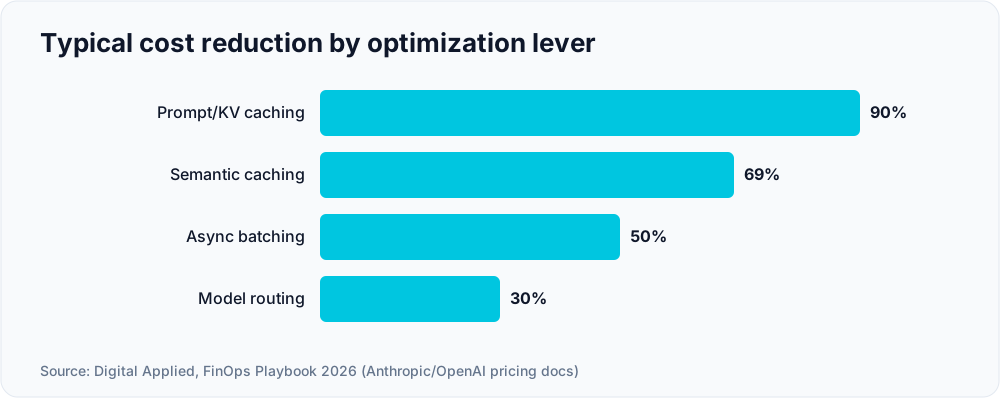
Cost-cutting advice for AI usually jumps straight to "use a cheaper model," which skips the levers that save more with less risk. Sourced from Anthropic's and OpenAI's own pricing documentation and peer-reviewed research on caching and quantization, the levers rank in a clear priority order for teams calling managed APIs rather than running their own infrastructure.
| Lever | Typical cost reduction | Effort |
|---|---|---|
| Prompt / KV caching | Up to 90% on cache-hit tokens | Low |
| Semantic caching | 61-69% fewer API calls | Medium |
| Async batching | 50% off sync rates | Low |
| Model cascade / routing | 30%+ | Medium |
Source: Digital Applied, AI Inference Cost Optimization: FinOps Playbook 2026, citing Anthropic and OpenAI pricing documentation.
Prompt and KV caching comes first because it carries no accuracy trade-off and returns the highest per-token savings for close to zero engineering effort: a workflow that repeats the same system prompt or reference document pays the full rate once and a fraction of it on every cache hit afterward. Async batching is the next easiest win for anything that does not need a synchronous response. Model routing, sending simple requests to a smaller model and reserving the frontier tier for genuinely hard tasks, comes later because it requires benchmarking against your own prompt distribution before you can trust it in production. Quantization only applies once a workload moves to self-hosted inference at real scale, which is a separate infrastructure decision, not a first move.
The metric that matters is not cost per token
The FinOps Foundation's recommended unit-economics metric is cost-per-successful-output, not cost-per-token or cost-per-call. A cheap model that fails a task and triggers a retry, or a cascade that hands off to a human anyway, can cost more per completed outcome than a pricier model that gets it right the first time. Tracking cost per token in isolation optimizes the wrong number and hides the workflows that are actually burning budget on rework.
That distinction is why AI cost control belongs next to the rest of operational reporting, not in a separate AI-only dashboard. A business intelligence layer that already tracks cost per order, per ticket, or per case is the natural place to add cost per completed AI task, so a finance or operations lead can see whether an automation is actually cheaper than the process it replaced, not just whether the API bill looks small.
Building AI cost visibility into how you already run the business
None of the five levers above require a new platform. They require someone accountable for reviewing inference spend against outcomes on a fixed schedule, the same way any other vendor cost gets reviewed, and a place to route that data next to the operational metrics it should be compared against. For most mid-market teams, that means treating AI inference as a monitored line item inside existing ERP and BI reporting rather than a separate tool nobody checks until the invoice arrives.
Two years ago fewer than a third of FinOps teams tracked AI spend at all. Now nearly all of them do, and the ones getting real ROI are the ones that measured cost per outcome from the first production rollout rather than after the first budget overrun. If your approach to AI adoption does not yet include a cost-per-outcome metric, that is the gap to close before scaling the next pilot, not after. Talk to ThinqHub about building that visibility into the operations you already run.